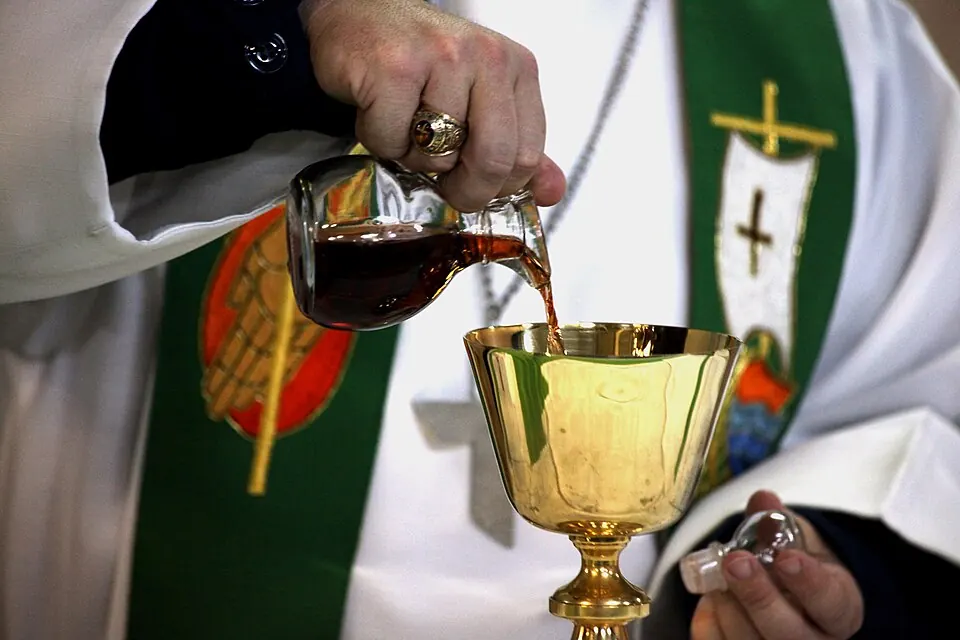

Sacramental wine is red or pink grape wine intended for use in the Eucharist. It is made from pure grape juice and is consumed during religious services.
History
Early Christians used wine to symbolize Christ's blood. In the Middle Ages, wine was only for priests in northern Europe, and laypeople received bread. This weakened the red color's symbolic importance, leading the Catholic Church to allow white wine. Eastern churches continued using both forms. In pre-Petrine Russia, wine was sometimes replaced by other drinks like cherry liqueur when unavailable. In the 20th century, after the Second Vatican Council, Catholics began receiving both bread and wine.
Types and styles
Most liturgical churches require pure grape wine. Orthodox churches usually use red wine. The Russian Orthodox Church prefers sweet Kagan, while the Greek Orthodox Church uses sweet Mavrodaphne. These sweet wines are used to prevent infants from spitting out the Communion. In Latin traditions without infant communion, dry wine is preferred. Some Protestant groups, like Methodists, use grape juice instead of wine.
How it is served
In the Byzantine rite, warm water called zeon is added to the wine before Communion. This practice symbolizes the water and blood that flowed from Christ's side. In the Roman rite, water is also added to the wine in the chalice.
Adapted from the Russian Wikipedia article Причастное вино, available under CC BY-SA 4.0.