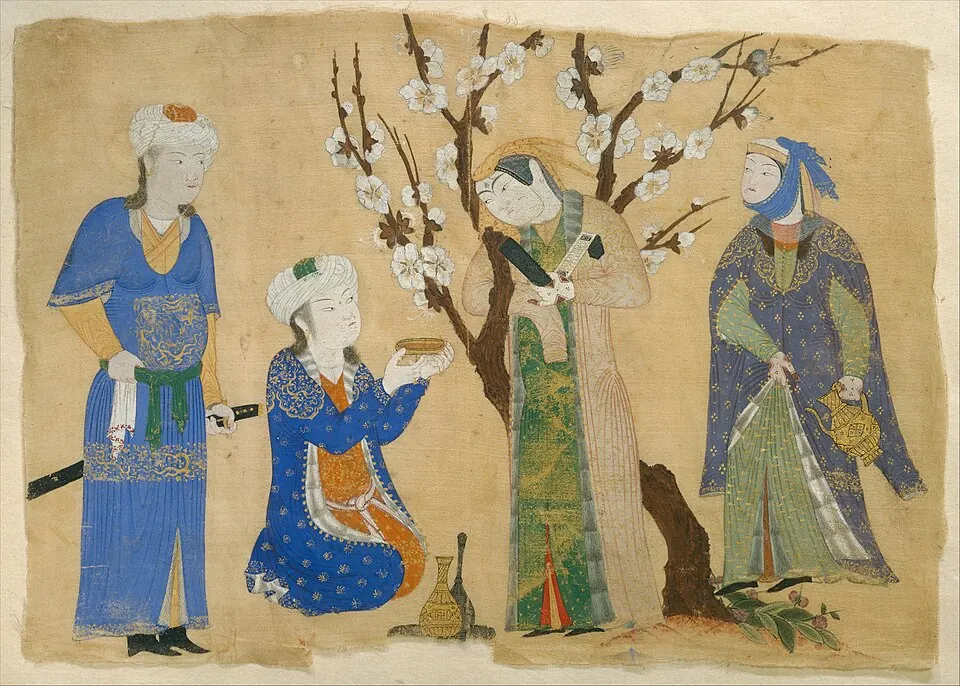

Khamr is an Arabic term referring to intoxicating substances, including alcohol. In Islamic law, it is strictly prohibited for Muslims to consume or trade. The word likely originates from the Aramaic language.
History
Before Islam, Arabs in the Syrian Desert and on the Arabian Peninsula consumed alcohol, including wine. Local wine was often of low quality and imported from Syria and Iraq. In southern Arabia, palm wine was a common drink. The prohibition of khamr in the Quran developed gradually. An early verse mentioned wine as a sign of God, but later verses progressively banned it. The final prohibition came in the 90th verse of Surah Al-Ma'idah, which states that khamr, gambling, idols, and archery are detestable acts of Satan. This prohibition led to a decrease in alcohol consumption among Muslims, though it varied by region.
Types and styles
Islamic legal scholars historically debated the exact definition of khamr. Early theologians, including the Hanafi school, believed the ban applied only to fermented beverages made from grape or date juice. Eventually, they joined other schools in prohibiting all alcoholic drinks. After the ban, cultivation of grapes continued on Muslim lands. Wine was produced by crushing grapes with feet and fermenting the juice in jars. Muslims also brewed several types of weak beer from sorghum, wheat, and barley, including a barley beer for consumption during Ramadan nights.
How it is served
Khamr is a religious concept rather than a drink type, so it is not served in cocktails. In modern Muslim countries, the legal status of alcohol varies. In some, it is banned and consumption can be punished with flogging as a moral crime. In others, it is legal. In Saudi Arabia, production, sale, and consumption are theoretically punishable by death, though authorities rarely prosecute individuals drinking at home. In Turkey, alcohol is legal and sold freely. In many Muslim-majority countries, official data on alcohol consumption is incomplete due to stigma and illegality.
Adapted from the Russian Wikipedia article Хамр, available under CC BY-SA 4.0.