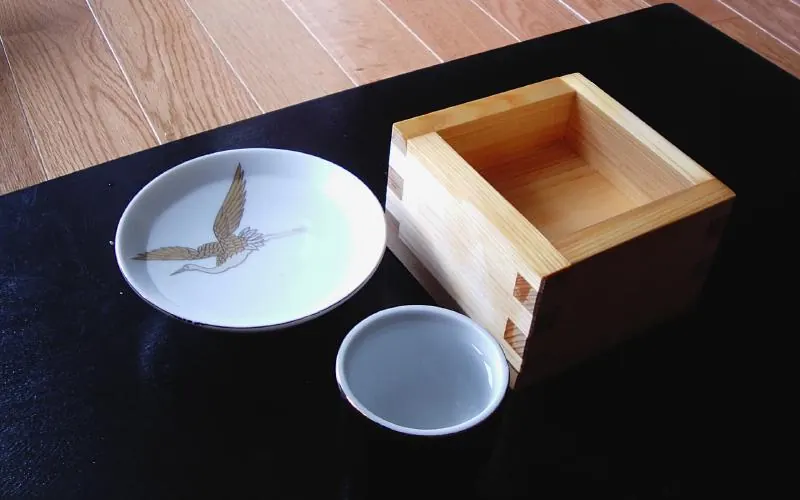

Sake is a traditional Japanese rice wine with a unique production process that sets it apart from other alcoholic beverages. Made from sake rice and koji mold, it has flavors ranging from fruity notes to hints of cheese and soy sauce, with an alcohol content of about 15%.
How it is made
The production of sake involves several meticulous steps. First, sake rice is polished to remove bran and germ, with the degree of polishing determining the quality category. The polished rice is then washed, soaked, and steamed. Koji mold is added to the steamed rice to create a starter culture, which is then mixed with water and yeast to begin fermentation. This mixture gradually incorporates more rice and water over several days before fermenting for 18-32 days. After fermentation, the sake is pressed, filtered, and often pasteurized before being diluted to the final alcohol content of approximately 15%.
History
The tradition of making sake in Japan dates back to the Jomon period, likely introduced from China. Initially produced only at imperial courts and Shinto temples, sake later became a village craft. Early production involved chewing rice and spitting it into containers to initiate fermentation. The introduction of koji mold as a fermentation starter occurred between the 7th-8th centuries. By the 17th century, sake production expanded commercially, with the Kinki region becoming the center of production. October 1st is recognized as Sake Day in Japan, established by the Japan Sake and Shochu Makers Association in 1978.
Types and styles
Sake is categorized into several types. 'Futsushu' is the standard table sake, accounting for 75% of production. 'Tokutei meishoshu' is premium sake, representing 25% of production. Within this category, 'Honjozo' has at least 30% of the rice polished and a small amount of distilled alcohol added. 'Junmai' is pure sake without additives, while 'Ginjo' has at least 40% of the rice polished and offers fruity and floral aromas. 'Daiginjo' is the highest grade, with at least 50% rice polishing, made from premium rice varieties and often served chilled.
How it is served
Sake can be served both chilled (as cold as 5°C) and heated (up to 60°C), depending on the type and personal preference. It is used in Japanese cuisine, sometimes to eliminate unpleasant odors in cooking. While sake consumption has decreased in Japan in recent years, demand has grown in the United States and France, particularly for premium varieties. On this site, sake is featured in cocktails such as Sake Bomb, Tamagozake, Japanese Cosmopolitan, Oriental Garden, Samurai, Japanese Sidecar, Questo Successo, Lotus Cocktail, Sottobosco, Chocolate Ocean, Oryzae Sour, Look At What the Light Did Now, Hidden Lady, and Sakura Martini.
Adapted from the Russian Wikipedia article Саке, available under CC BY-SA 4.0.
Kinds of sake
Other styles
- Kuchikamizake
- Nigori (Japan)
- Sato
- Omiki
- Doburoku (Japan)
- Akumochizake