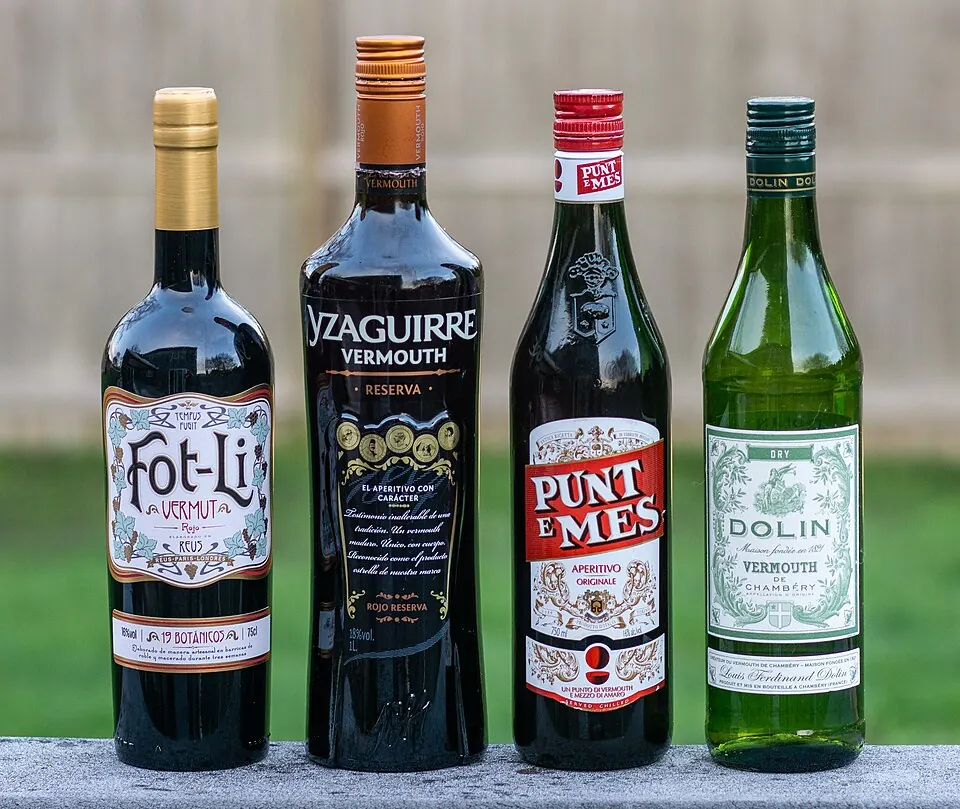

Vermouth is an aromatised wine flavoured with herbs and spices. It originated in Italy in the late 18th century and typically has an alcohol strength between 16-18% ABV.
History
Before vermouth, aromatised wines were typically used for medicinal purposes. The first vermouth production enterprise was established by Antonio Benedetto Carpano in Turin in 1786. Sweet vermouth was initially served in Turin cafes as an apertif specifically for women. Dry vermouth was first produced by French Joseph Noilly in the Provençal city of Marseillan between 1800-1813.
How it is made
Most vermouths use white, neutral wines, though some also include red wines. The red color in most sweet red vermouths comes from added caramel. For flavoring, a large number of different herbs, flowers, seeds, and roots are used. The main component is wormwood, which can make up to 50% of all flavorings. Other common ingredients include yarrow, mint, cinnamon, cardamom, black elderflower, and nutmeg. All plant materials are dried and crushed, then infused in a water-alcohol solution in large rotating tanks for about twenty days.
Types and styles
Vermouths are divided into five main groups: Vermouth Secco (dry) with less than 4% sugar; Vermouth Bianco (white) with 10-15% sugar; Vermouth Rosso (sweet red) with over 15% sugar; Vermouth Rose with sugar content between white and red; and Vermouth Bitter, used as a digestif. Classic vermouths come from Italy and France, with major producers including Martini, Campari, Carpano, Cinzano, Lillet, and Noilly Prat.
How it is served
Vermouth is a key ingredient in many classic cocktails including Negroni, Manhattan, Americano, Derby, Martini, Dry Martini, Dirty Martini, French Connection, Vodka Martini, Appletini, Boulevardier, Martinez, Bronx, and Rob Roy. It is also used in cooking as an alternative to white wine in some recipes.
Adapted from the Russian Wikipedia article Вермут, available under CC BY-SA 4.0.
Styles and varieties
- Punt e Mes
- Rosso Antico (Italy)
Well-known brands
- Martini (Italy)
- Noilly Prat (France)